|
|
Diplichnites"First
Footprints on Land"
|
|
|
Diplichnites
is an ichnogenus normally attributed to arthropod locomotion.
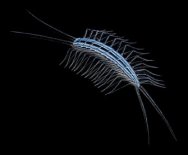
The fossil trackway exhibits two parallel lines The Diplichnites shown to the right is unique owing to the obvious large size of the animal, since the sides of the tracks are some two inches apart. Note that this large specimen is the convex half of the fossil (called hyporelief) (e.g., see Stranded on a Late Cambrian shoreline: Medusae from central Wisconsin, by Hagadorn, et. al., describing Ichnology). This particular plate measures 775 by 140 (30 1/2 by 5 1/2 inches), and a yardstick is shown to give perspective. A popular conjecture was that Diplichnites is the trace of a wandering Myriapod, which brings to mind an ancient centipede (Chilopoda). Given the spacing of these footprints, the centipede that made the tracks of the fossil to the right would have been an awesome predator - perhaps the terror of the Cambrian beach some 1/2 billion years ago. Diplichites from other locations have been attributed to trilobites. Many ichnofossils, Protichnites, from the Mount Elk Group show drag traces putatively made by arthropod tails or other body parts, suggesting taxonomic identity among crustaceans, aglaspids, chelicerates or euryipterid stem group. The more accepted interpretation is now that the Diplichnites from Blackberry Hill are deep footprints made in a preserved by a thick microbial mat on which the animal walked. |